
 by
by By Maier Law, P.A.
Key Takeaways
|
Construction site accidents that injure the public can turn an ordinary drive, walk, or delivery into a life-changing emergency in seconds. When an active commercial project injures a pedestrian, driver, visitor, or delivery worker, the legal review must identify the source of the harm. It must also trace responsibility to the people, equipment, records, and decisions that controlled the project.
A construction zone does not stop at the property line. Palm Beach County projects around the CityPlace district, Flagler Drive, and the downtown waterfront sit beside public roads, retail areas, office buildings, residences, and sidewalks.
Heavy equipment, truck traffic, missing barriers, moving debris, and unsafe access routes can place people in immediate danger.
At Maier Law, P.A., our mission is to offer a full spectrum of legal solutions to our clients. From construction law and personal injury law to investment fraud loss recovery, we provide cost-effective, creative pre-suit negotiation strategies and litigation services throughout Florida and in federal courts.
Why Active Commercial Projects Put the Public at Risk
 Construction activity can change a familiar roadway or sidewalk without notice. A delivery driver can enter a new traffic pattern. A pedestrian can step beside a reversing truck. A motorist can encounter loose concrete or steel fragments in an open travel lane.
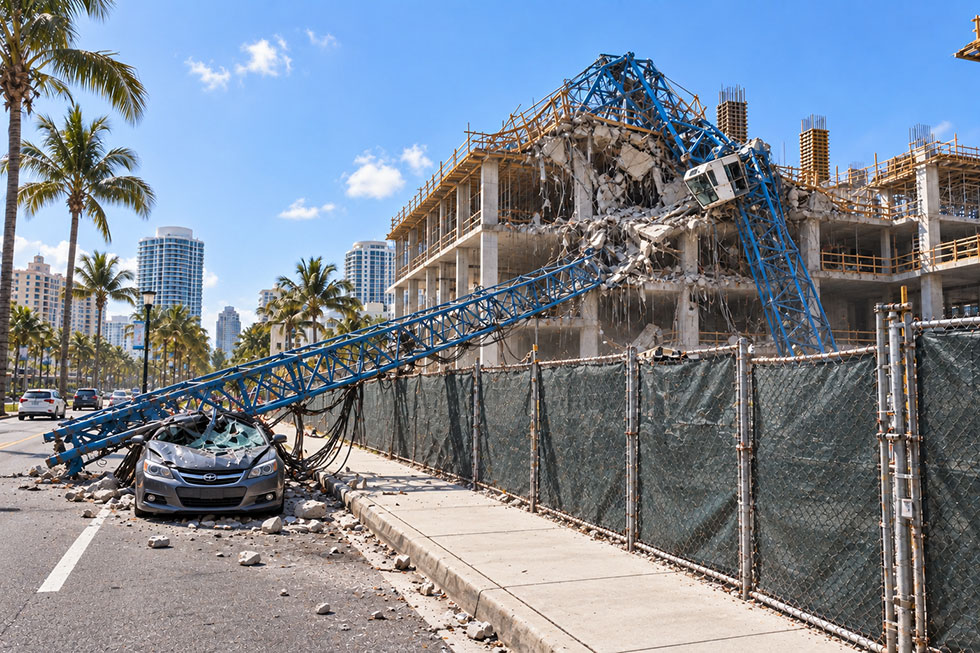
On September 14, 2026, an 85-foot drilling rig collapsed near Southeast 12th Street and Brickell Bay Drive in Miami. It struck three vehicles and a construction container, and four people went to hospitals with minor injuries after the Brickell collapse.
No news report determines legal fault. The incident shows how quickly equipment, access routes, and traffic flow can create a public safety crisis.
On February 18, 2026, a 53-year-old pedestrian died after a backing dump truck struck him near a Parrish subdivision project. This commercial development sat beside active operations. The tragedy illustrates the danger posed by vehicle blind spots and inadequate separation between public access areas and heavy equipment.
Roadway work poses its own hazards. Loose asphalt, steel shrapnel, and concrete fragments can shatter windshields or cause abrupt swerving collisions. Construction firms must account for debris control, travel-lane protection, street sweeping, barriers, signs, and safe delivery routes before the first truck moves.
Legal Responsibility Starts With Control and Evidence
A serious public injury does not make one company automatically liable. Responsibility follows the facts. The legal analysis focuses on who controlled the work, who created the hazard, who had a duty to correct it, and what records show about the incident.
The parties involved can include a general contractor, developer, property owner, subcontractor, equipment operator, rental company, architect, engineer, traffic-control vendor, or insurer. Large projects often involve several of these parties at once.
Contracts, scopes of work, site plans, equipment records, and insurance policies help identify each party’s role.
The questions are direct. Who approved the traffic pattern? Who maintained the equipment? Who placed the barriers? Who directed public access around the project? Who had notice that a condition created a danger?
Legal Responsibility Starts With Control and Evidence
A serious public injury does not make one company automatically liable. Responsibility follows the facts. The legal analysis focuses on who controlled the work, who created the hazard, who had a duty to correct it, and what records show about the incident.
The parties involved can include a general contractor, developer, property owner, subcontractor, equipment operator, rental company, architect, engineer, traffic-control vendor, or insurer. Large projects often involve several of these parties at once.
Contracts, scopes of work, site plans, equipment records, and insurance policies help identify each party’s role.
The questions are direct. Who approved the traffic pattern? Who maintained the equipment? Who placed the barriers? Who directed public access around the project? Who had notice that a condition created a danger?
| “An injury claim tied to construction begins with the facts on the ground. The plans, equipment records, and site controls show where responsibility belongs.”
– Jason C. Maier, Managing Partner |
Preserve the Facts Before the Site Changes
Once equipment moves, debris is cleared, or repairs begin, the proof can change. At Maier Law, P.A., we help clients focus on the records that explain how a project operated at the moment of the incident. Our construction law practice allows us to review the construction details along with the injury facts.
Useful evidence includes:
- Surveillance video, dashcam footage, photographs, and incident reports
- Site logistics plans, traffic-control plans, and pedestrian-routing plans
- Equipment inspection records, maintenance logs, and operator records
- Contracts, subcontracts, scopes of work, and change orders
- Permits, inspection records, safety logs, and witness statements
- Insurance notices, preservation letters, and communications about repairs
This review benefits injured people and commercial construction firms. It can preserve a claim, protect a defense, and stop key records from disappearing.
When a Construction Defect Injury Attorney Is Needed
Completing a project does not erase responsibility for unsafe work. A newly opened commercial building can still injure a customer, tenant, visitor, driver, or resident when the completed structure contains a dangerous condition.
Uneven stair risers, cracked walkways, failing handrails, crumbling concrete, and settlement cracking in recently built commercial structures create risk long after the fences come down. A construction defect injury attorney traces the injury back through design documents, construction records, inspections, repairs, and maintenance history.
These defective construction personal injury cases often involve more than one legal issue. The claim can involve negligence, premises liability, products liability, construction defects, insurance coverage, and contractual responsibility at the same time.
In one matter, we represented a client who fell on a concrete staircase built outside code. The construction evidence showed why the angled treads created a serious fall hazard, and the case resulted in a $1.35 million recovery.
Jason explains, “A completed project can still leave behind dangerous work. The legal review has to examine the structure, the records, and every party that created or ignored the condition.”
Construction Knowledge Changes the Legal Review
 Jason C. Maier has been Florida Bar Board-Certified in Construction Law since 2006. He has practiced Florida law since 2000 and represents clients in Florida state and federal courts. His work includes construction contracts, construction defects, negligence claims, personal injury, insurance disputes, and matters involving architects and engineers.
A construction defect injury attorney must understand the injury and the construction record. That includes plans, specifications, permits, inspection reports, change orders, design responsibilities, warranty language, and the insurance provisions that can shape the dispute.
This background matters when an active-site accident involves project control. It also matters when a completed structure harms someone months or years later.
Jason is Managing Partner of Maier Law, P.A., brings those issues into one legal review instead of treating them as separate problems.
What Injured People and Families Should Do After a Serious Construction Accident
Medical care comes first. Get emergency treatment, follow the care plan, and save records of symptoms, appointments, prescriptions, medical bills, and missed work. These records connect the injury to the accident.
Take these steps as soon as possible:
- Report the incident to law enforcement, the property owner, or site personnel and request a copy of every report.
- Photograph the scene, the hazard, your injuries, damaged property, barriers, signs, equipment, and vehicle damage.
- Write down the time, exact location, and names of witnesses.
- Keep damaged clothing, personal property, receipts, and all communications about the incident.
- Do not sign a release, accept a quick settlement, or give a recorded statement to an insurer before the facts and injuries are reviewed.
Construction sites can change within hours. Equipment may be removed. Video may be overwritten. The area may be repaired before anyone documents the dangerous condition. Legal counsel can send preservation demands for surveillance footage, site plans, equipment records, inspection reports, maintenance logs, contracts, and project communications.
“The evidence at a construction site can change within hours. We move quickly to protect the record and identify every party responsible for an injured person’s losses,” says Jason.
Talk With a West Palm Beach Construction Litigation Lawyer
Fast legal action protects the facts after construction site accidents that injure the public. Contact Maier Law, P.A. through our injury and negligence practice to discuss a serious construction-related injury, a wrongful death matter, or a commercial project that needs responsive legal counsel.
Simply click here, call us today at (561) 318-6589, or visit us at 500 S Australian Ave, Suite 500, West Palm Beach, FL.
Note: This information is for general guidance and should not be considered legal advice.
 About Jason C. Maier, Esq.
Jason C. Maier is Managing Partner at Maier Law, P.A. He has 25 years of trial and arbitration experience and can represent clients nationwide in financial fraud and negligence cases. His record includes success in complex financial disputes before both judges and arbitration panels. Jason has earned recognition for his focus on investor recovery and client advocacy.