

 by
Key Takeaways
|
Construction contract disputes can burn through your project’s profit before the concrete starts to cure. Who pays for delays and cost overruns depends on the contract, the cause of the problem, and proof of the resulting loss.
 An over-budget project does not automatically entitle your company to collect the difference from the owner.
For large contractors working across Palm Beach County, one late design decision can affect several trades. Extended supervision, idle equipment, and overtime add costs. Recovering those expenses requires a contractual or legal basis and records connecting the added expense to the responsible party.
At Maier Law, we help construction firms evaluate that exposure and pursue contract remedies. Managing Partner Jason C. Maier is a board certified construction attorney.
Our West Palm Beach construction lawyer works with contractors on contract review, pre-suit negotiation, arbitration, and litigation throughout Florida.
Who Pays When a Commercial Construction Project Runs Late?
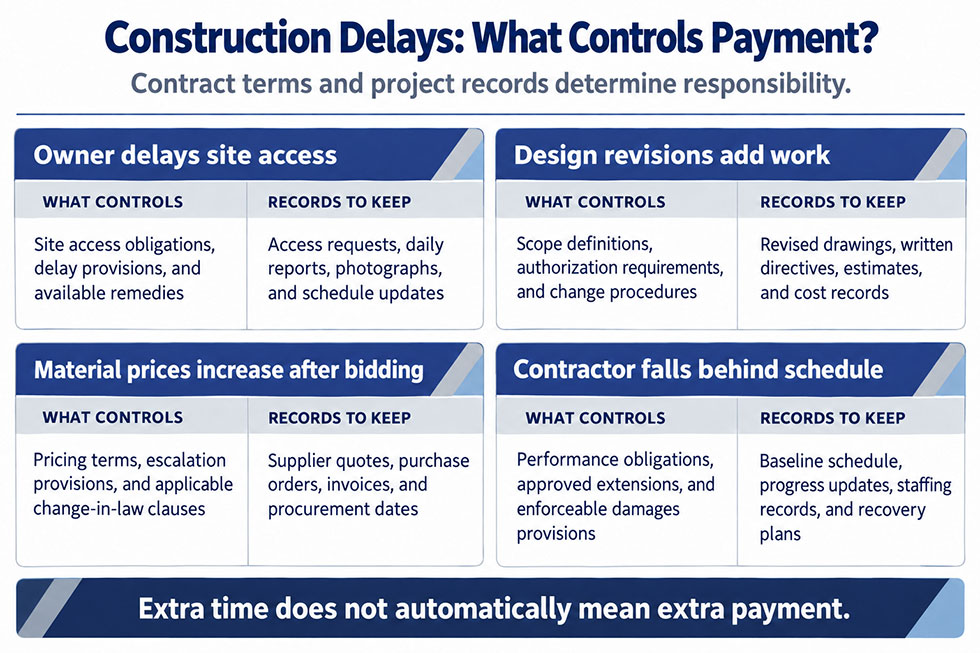
Your contract sets the starting point for deciding who pays. Responsibility depends on what caused the delay or added expense, which party accepted that risk, and what remedies the agreement allows.
When an owner restricts access or design revisions add work, review the site access and change order provisions. Written requests, revised plans, field reports, and cost records help show how those events affected your work.
Higher material prices require a different analysis. Pricing and escalation clauses determine how the parties allocated that risk. Supplier quotes, purchase commitments, and invoices establish when costs changed and by how much.
If your company falls behind schedule, examine its performance obligations, approved extensions, and potential delay damages. Schedule updates, staffing records, and recovery efforts help explain the cause and your response.
Additional time does not automatically include additional payment. Support each request with the contract language and records connecting the event to its financial impact.
| “Extra time and extra money are separate contract questions. Contractors need to document and preserve both.” – Jason C. Maier, Managing Partner |
 Which Contract Clauses Control Delay and Cost Claims?
Florida courts enforce contract language allocating construction risk, subject to applicable law. Before asserting a breach of construction contract, review the provisions that define your rights and limit your recovery.
Notice Requirements and Claim Deadlines
Your agreement can require written notice within a stated period after an event. It can also identify the recipient, delivery method, and supporting information.
An email complaining about slow approvals must satisfy the contract’s requirements to serve as formal claim notice. Follow the specified procedure and retain proof of delivery. Late notice creates a separate dispute over entitlement, even when your underlying costs are real.
No-Damages-for-Delay Clauses
A no-damages-for-delay clause can restrict a contractor’s remedy to additional time. Florida recognizes these provisions, along with exceptions involving fraud, bad faith, or active interference with performance.
The Florida Bar’s discussion of local government construction contracts explains these limits and the decisions applying them. An owner-caused delay alone does not establish an exception. The contract and the owner’s conduct require separate analysis.
Liquidated Damages
Liquidated damages provisions establish an agreed amount for specified breaches, such as late completion. Their enforceability under Florida law depends on the applicable legal test. That includes uncertainty of damages when the parties contracted and the relationship between the stipulated amount and reasonably anticipated harm.
Review the amount, the completion milestone, approved extensions, and any owner contribution to delay. A daily rate printed in the agreement does not end the analysis.
How Owner Changes Create Additional Costs
Late selections, revised drawings, and restricted work areas can force your team to change the sequence of construction. The cost extends beyond the revised work itself. Crews lose productivity when they move repeatedly between unfinished areas.
On a phased development such as Avenir in Palm Beach Gardens, infrastructure and building work provide a useful context for discussing coordination. Consider a hypothetical owner directive that changes utility routing before a commercial building begins. The contractor must identify the added scope and any resulting effect on later activities.
This example does not describe an actual dispute at Avenir. It shows why a change order should address price, time, and related impacts together.
Before signing, review the release language. A change order that pays for extra materials can also contain language releasing delay or disruption claims. Identify unresolved impacts and address them expressly in the document.
 Do Higher Material Prices Entitle Your Firm to More Money?
A price increase does not automatically transfer the expense to the owner. Under a fixed-price agreement, the contractor assumes the pricing risk allocated by that contract. An escalation clause or another applicable provision can change that allocation.
For tariff-related claims, compare the contract date, purchase commitment, affected materials, and relevant contract language. Determine if the agreement treats the event as a price adjustment, a change in law, an excusable delay, or a contractor risk.
A force majeure clause also requires careful reading. Permission to finish later does not automatically include reimbursement for higher procurement costs.
Maier Law reviews the contract alongside supplier records and project correspondence. That work separates a documented claim from an expense the agreement assigns to your company.
What Coastal and Public Projects Teach Contractors About Scheduling
Palm Beach County projects bring different constraints to the schedule. Coastal access, environmental restrictions, and public procurement requirements deserve attention before your team prices the work.
The Town of Palm Beach reported that the Mid-Town Beach Renourishment project completed dredging on May 25, 2026. Crews placed nearly 600,000 cubic yards of sand. The project description called for work 24 hours a day, seven days a week, and identified sea turtle nesting season as a scheduling constraint.
Those verified details illustrate why contractors must evaluate work windows, staging, and demobilization when allocating risk. They do not establish that the project had a legal dispute or compensable delay.
The county’s Library Expansion Plan III provides another local example. The program includes renovation, expansion, and new construction over multiple decades. For a contractor bidding county work, public contract requirements deserve separate review from the forms used on private developments.
Public property does not carry the same construction lien remedies as private property under Florida’s construction lien law. Evaluate the applicable contract, statutory procedures, and available payment security before selecting a remedy. Do not assume your private-project claim process applies to a county contract.
 What Your Firm Needs to Prove Its Losses
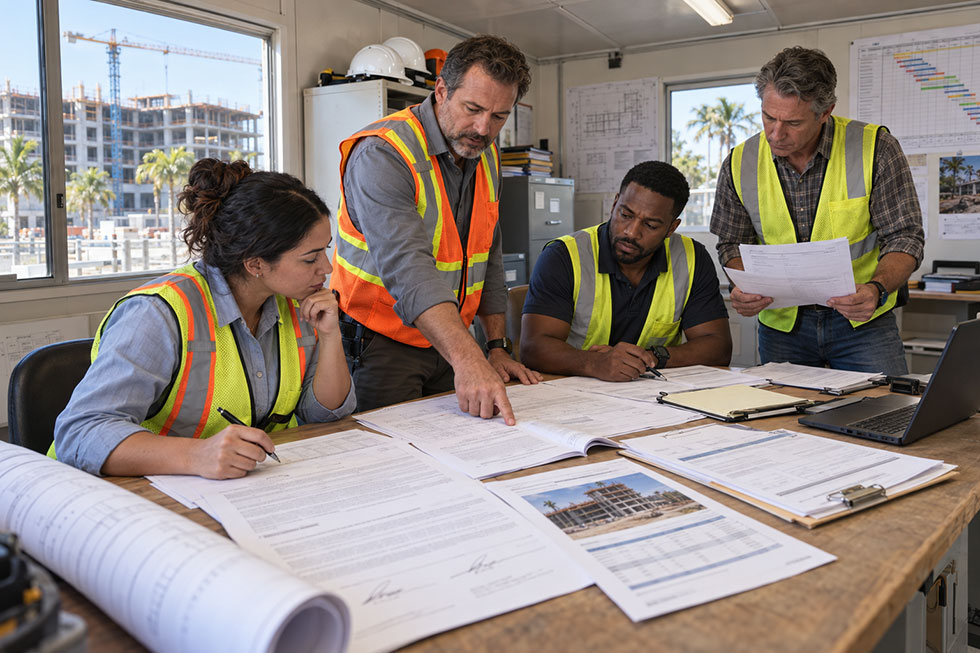
Resolving construction contract disputes requires evidence connecting the event, the schedule impact, and the dollars claimed. A final project loss does not establish who caused it.
Keep the following records organized as work progresses:
- Contract documents: Executed agreements, amendments, specifications, and incorporated schedules.
- Written notices: Delay notices, change requests, responses, and proof of delivery.
- Schedule evidence: Baseline schedules, updates, activity relationships, and recovery plans.
- Field records: Daily reports, photographs, manpower counts, and equipment logs.
- Cost support: Payroll, invoices, job cost codes, and records of added supervision.
- Decision history: Meeting minutes, design responses, approvals, and owner directives.
A schedule analysis identifies the activities controlling completion. If an owner event and a contractor event overlap, the claim must address their actual effects. Labeling every late activity an owner delay leaves a gap in the proof.
Contractors also need to document reasonable steps taken to reduce avoidable losses. Record the alternatives considered, their costs, and the reasons for the selected approach.
“A project loss shows the financial result. A supported claim explains what caused it and why another party owes payment,” explains Jason.
How a Board Certified Construction Attorney Evaluates Your Options
The first task is to identify the claim, the deadlines, and the procedure the contract requires. Executive negotiation, mediation, arbitration, and litigation serve different roles. Your agreement can require specific steps before a formal filing.
 Our legal team helps connect the legal analysis with the records your project managers and accounting staff maintain. We assess responsibility, available remedies, and the evidence needed to support or defend the claim.
Effective construction dispute settlement starts with a defined financial position. That includes the amount sought, the risks of proceeding, and the effect of any proposed release.
When negotiation does not resolve the matter, our construction litigation services address the next required step. We prepare for the forum established by the contract and applicable law.
Jason clarifies, “A settlement should identify what it resolves, what rights remain, and what each party must do next.”
Frequently Asked Questions
Does an Owner-Caused Delay Automatically Entitle a Contractor to Payment?
No. The contractor must establish a basis for recovery, address contractual limitations, satisfy applicable claim requirements, and prove the resulting damages. An extension of time does not automatically include compensation.
Can a Contractor Recover Material Increases Under a Fixed-Price Contract?
A higher supplier invoice alone does not establish entitlement. Recovery requires a contractual or legal basis, such as an applicable escalation provision, authorized scope change, or compensable breach.
Does Severe Weather Excuse Every Construction Delay?
No. The contract’s weather provisions, notice requirements, and the event’s actual effect on performance control the claim. Ordinary seasonal conditions and extraordinary weather require different factual analysis.
What Happens When Both Parties Contribute to a Delay?
The analysis must separate the causes, affected activities, and periods of overlap. Contract terms and the evidence determine the effect on time extensions and monetary recovery.
Should a Contractor Sign a Change Order Containing a Release?
Review the release before signing. Its language can extend beyond the direct price of the added work. Address pending time, overhead, and disruption claims expressly rather than assuming they remain open.
Protect Your Project’s Contract Rights With Maier Law
Your project team needs legal advice while it still has time to act on notices, preserve records, and assess settlement terms. Working with a West Palm Beach construction lawyer gives your Palm Beach County firm local access to counsel for projects throughout Florida.
At Maier Law, we offer a full spectrum of legal solutions, including construction law, personal injury, and investment fraud loss recovery. We provide cost-effective, creative pre-suit negotiation strategies and litigation services in Florida state and federal courts.
For contractors facing substantial project exposure, our board certified construction attorney focuses on the contract, the evidence, and the next decision your business needs to make.
Click here. call us today at (561) 318-6589, or visit us at 500 S Australian Ave, Suite 500, West Palm Beach, FL.
Note: This information is for general guidance and should not be considered legal advice.
About Jason C. Maier, Esq.
Jason C. Maier is Managing Partner at Maier Law, P.A. He has 25 years of trial and arbitration experience and can represent clients nationwide in financial fraud and negligence cases. His record includes success in complex financial disputes before both judges and arbitration panels. Jason has earned recognition for his focus on investor recovery and client advocacy.